


Key Insights
The global Lithium and Cobalt Recycling market is poised for extraordinary growth, projected to reach USD 5.38 billion in 2025 with an impressive CAGR of 22.24% through 2033. This surge is primarily driven by the escalating demand for electric vehicles (EVs) and portable electronics, both of which rely heavily on lithium-ion batteries. As governments worldwide implement stricter regulations on battery disposal and promote circular economy principles, the recovery of valuable metals like lithium and cobalt from spent batteries is becoming not just an environmental imperative but also a significant economic opportunity. The automotive sector, in particular, is a dominant force, with the increasing adoption of EVs necessitating robust battery recycling infrastructure to secure raw material supply chains and mitigate environmental impact. Industrial applications and the rapidly expanding electric power sector, including grid-scale energy storage, also contribute to this robust market expansion.
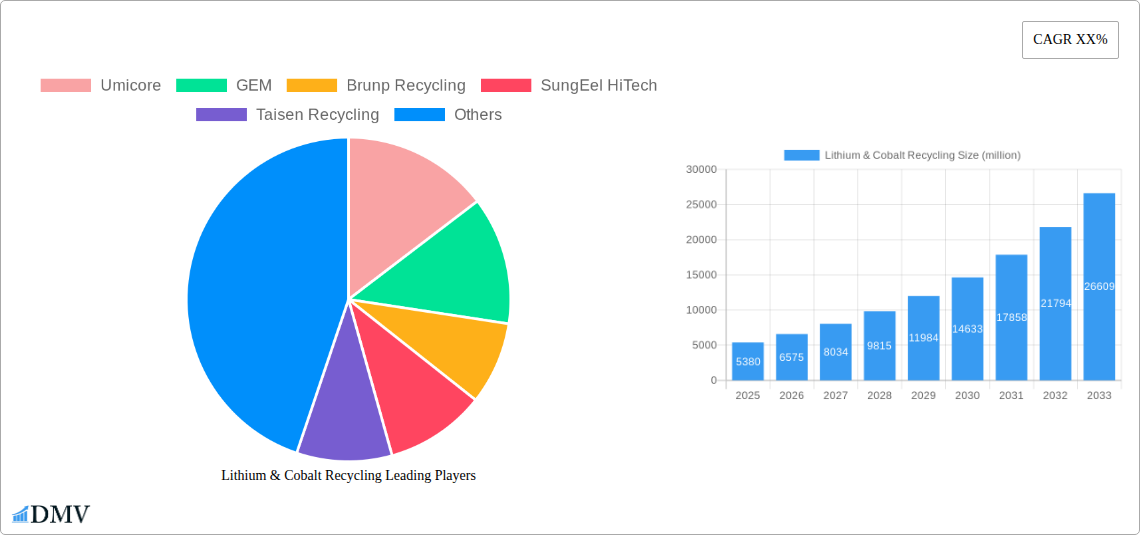
Lithium & Cobalt Recycling Market Size (In Billion)

Emerging trends such as advancements in recycling technologies, including hydrometallurgical and pyrometallurgical processes, are enhancing efficiency and the recovery rates of critical materials, further stimulating market development. Companies are investing heavily in research and development to create more sustainable and cost-effective recycling solutions. However, challenges such as the collection and logistics of spent batteries, and the establishment of standardized recycling processes across different regions, present hurdles. Despite these, the immense potential for resource conservation, reduced reliance on primary mining, and the growing environmental consciousness are set to propel the Lithium and Cobalt Recycling market to new heights. The Asia Pacific region, led by China, is expected to dominate this market due to its significant manufacturing base for batteries and EVs, followed by Europe and North America, driven by supportive policies and increasing consumer awareness.
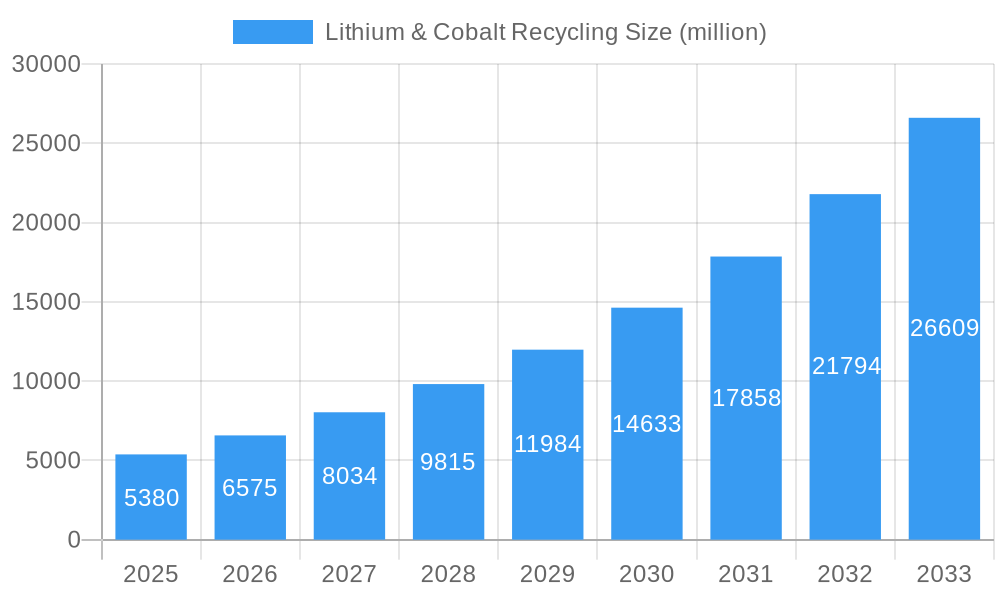
Lithium & Cobalt Recycling Company Market Share
This comprehensive report, "Lithium & Cobalt Recycling Market Analysis & Future Outlook (2019-2033)," offers an in-depth examination of the burgeoning global market for recycling critical battery materials. Analyzing the period from 2019 to 2033, with a base year of 2025 and a forecast period of 2025-2033, this report provides unparalleled insights into market composition, industry evolution, regional dominance, product innovations, growth drivers, obstacles, and future opportunities. Leveraging high-ranking keywords such as "lithium recycling," "cobalt recycling," "battery recycling," "electric vehicle battery recycling," and "circular economy," this report is essential for stakeholders seeking to navigate and capitalize on this rapidly expanding sector.
Lithium & Cobalt Recycling Market Composition & Trends
The lithium and cobalt recycling market exhibits a dynamic and evolving composition, driven by increasing battery production and stringent environmental regulations. Market concentration is gradually shifting, with a growing number of specialized recycling companies emerging alongside established players. Innovation catalysts are numerous, ranging from advanced hydrometallurgical and pyrometallurgical processes to novel direct recycling techniques, aiming for higher recovery rates and purity. The regulatory landscape is a significant factor, with governments worldwide implementing policies that promote battery end-of-life management and incentivize recycling. Substitute products, while not directly replacing the need for lithium and cobalt, can indirectly influence demand for recycled materials by impacting the adoption rates of different battery chemistries. End-user profiles are diverse, encompassing automotive manufacturers seeking to secure supply chains, industrial users of batteries, and electric power companies involved in grid-scale energy storage. Mergers and acquisitions (M&A) activities are on the rise as companies consolidate expertise and expand capacity to meet escalating demand. M&A deal values are projected to reach billions of dollars as companies strategically position themselves in this high-growth sector. For instance, the overall M&A market is estimated to be in the tens of billions of dollars, with individual deals potentially exceeding hundreds of millions of dollars.
- Market Concentration: Fragmented with increasing consolidation.
- Innovation Catalysts: Advanced hydrometallurgy, pyrometallurgy, direct recycling.
- Regulatory Landscape: Stringent mandates for battery disposal and recycling.
- Substitute Products: Limited direct substitutes for lithium and cobalt in current battery tech.
- End-User Profiles: Automotive, industrial, electric power sectors.
- M&A Activities: Growing consolidation and strategic partnerships.
- Estimated M&A Deal Value: Billions of US Dollars.
Lithium & Cobalt Recycling Industry Evolution
The lithium and cobalt recycling industry is undergoing a profound transformation, marked by exponential growth and technological sophistication. The historical period (2019-2024) witnessed the foundational stages of widespread adoption for electric vehicles (EVs), leading to an increased volume of end-of-life batteries. This surge in battery waste, initially perceived as a challenge, has catalyzed significant investment and innovation in recycling infrastructure and processes. The base year (2025) signifies a critical inflection point where recycling operations are becoming increasingly efficient and economically viable, driven by both environmental pressures and the intrinsic value of recovered materials.
Market growth trajectories are steeply upward, projected to accelerate throughout the forecast period (2025-2033). This growth is fueled by several interconnected factors. Firstly, the sheer volume of EV batteries entering the recycling stream is expected to multiply. As EV adoption rates continue to climb globally, the pipeline of spent batteries will expand proportionally. Analysts predict an annual growth rate of over 25% for the lithium and cobalt recycling market in the coming years. Secondly, technological advancements are continuously improving the efficiency and cost-effectiveness of recycling processes. Companies are moving beyond traditional pyro- and hydrometallurgical methods to develop more sustainable and resource-efficient techniques, such as direct recycling, which can recover battery materials with significantly less energy and fewer chemical inputs. Adoption metrics for these advanced technologies are steadily increasing as pilot projects demonstrate their commercial viability.
Shifting consumer demands and corporate sustainability goals are also playing a crucial role. Consumers are increasingly conscious of the environmental impact of their purchases, favoring brands and products that demonstrate a commitment to sustainability. This translates into greater demand for products manufactured using recycled materials, creating a virtuous cycle for the battery recycling industry. Furthermore, governments worldwide are implementing stricter regulations and policies mandating battery recycling and promoting the circular economy, further propelling market expansion. For example, the European Union's Battery Regulation sets ambitious targets for collection and recycling efficiency. The estimated market size for lithium and cobalt recycling is poised to reach tens of billions of US dollars by 2025, with projections indicating growth into the hundreds of billions of US dollars by 2033.
Leading Regions, Countries, or Segments in Lithium & Cobalt Recycling
The dominance within the lithium and cobalt recycling market is multifaceted, with leadership emerging across specific regions, countries, and application segments. Geographically, Asia-Pacific stands out as a leading region, primarily driven by the manufacturing prowess of countries like China. This dominance is attributed to several key factors:
- Massive EV Production Hub: China is the world's largest producer and consumer of electric vehicles, generating a substantial volume of end-of-life batteries requiring recycling.
- Proactive Regulatory Framework: The Chinese government has implemented comprehensive policies and regulations to support and mandate battery recycling, fostering an environment conducive to industry growth. This includes setting ambitious recycling targets and offering incentives for recycling facilities.
- Established Recycling Infrastructure: Significant investments have been made in developing a robust recycling infrastructure, including advanced processing plants and collection networks, enabling efficient recovery of valuable materials.
- Strategic Material Sourcing: The concentration of battery manufacturing in the region naturally leads to a greater availability of spent batteries for local recycling operations, reducing logistical complexities and costs.
In terms of application segments, Automotive is the undisputed leader. The rapid proliferation of electric vehicles globally has made the automotive sector the primary generator of lithium-ion battery waste.
- Exponential EV Growth: The escalating adoption rates of EVs worldwide directly translate into a growing volume of end-of-life EV batteries entering the recycling stream.
- Supply Chain Security: Automakers are increasingly focused on securing a stable and sustainable supply of critical battery materials like lithium and cobalt. Recycling offers a domestic and environmentally friendly alternative to traditional mining, mitigating geopolitical risks and price volatility.
- Circular Economy Initiatives: Leading automotive manufacturers are actively investing in or partnering with recycling companies to establish closed-loop systems, ensuring that materials from old batteries are incorporated into new ones. This commitment aligns with broader corporate sustainability goals and enhances brand reputation.
- Technological Advancements in Battery Design: Innovations in battery technology for EVs, while diverse, are contributing to the complexity and the necessity of specialized recycling solutions.
When considering the types of recycling, both Cobalt Recycling and Lithium Recycling are critical. However, given the current battery chemistries and the high value of cobalt, dedicated cobalt recycling processes are highly sought after.
- High Value of Cobalt: Cobalt is a valuable and often ethically sourced commodity, making its recovery from spent batteries economically attractive.
- Limited Supply and Geopolitical Concerns: The concentration of cobalt mining in specific regions and associated ethical concerns further drive the demand for recycled cobalt.
- Growing Demand in Advanced Chemistries: While battery chemistries are evolving to reduce cobalt content, it remains a crucial component in many high-performance batteries, ensuring continued demand for recycled sources.
- Efficiency in Lithium Recovery: Advances in lithium recycling processes are crucial for meeting the sheer volume demand stemming from widespread EV adoption, making efficient lithium recovery vital for the overall sustainability of the battery ecosystem.
Lithium & Cobalt Recycling Product Innovations
Product innovations in lithium and cobalt recycling are centered on enhancing recovery rates, purity, and environmental sustainability. Companies are developing advanced hydrometallurgical processes that utilize selective leaching and solvent extraction to efficiently separate and purify lithium, cobalt, nickel, and manganese. Pyrometallurgical advancements focus on energy-efficient smelting techniques that minimize emissions and maximize material recovery. A key innovation is the emergence of direct recycling methods, which aim to bypass the energy-intensive shredding and chemical separation stages to directly recover active cathode materials, preserving their structural integrity for reuse in new batteries. These innovations are crucial for meeting the stringent purity requirements of battery manufacturers and for reducing the overall carbon footprint of battery production. Performance metrics are steadily improving, with recovery rates for key metals often exceeding 95% and purity levels reaching battery-grade specifications.
Propelling Factors for Lithium & Cobalt Recycling Growth
The lithium and cobalt recycling market is propelled by a confluence of powerful forces, creating an environment ripe for substantial growth. Technological advancements are at the forefront, with continuous innovation in pyro-, hydro-, and direct recycling methods leading to higher recovery rates, improved purity of recycled materials, and reduced processing costs. This makes recycled materials increasingly competitive with primary sources. Economic drivers are also pivotal, including the soaring demand for EVs and energy storage systems, which in turn drives the demand for battery materials. The volatile prices and limited supply of virgin lithium and cobalt make recycled materials an attractive and cost-effective alternative, offering greater price stability and supply chain security. Regulatory influences are significant, with governments worldwide implementing stringent mandates for battery collection, recycling, and the incorporation of recycled content in new batteries. Examples include the EU's Battery Regulation and various national policies promoting the circular economy, all of which create a captive market for recycled battery materials. The growing awareness and demand for sustainable products among consumers and corporations further incentivize the adoption of recycling solutions.
Obstacles in the Lithium & Cobalt Recycling Market
Despite its immense growth potential, the lithium and cobalt recycling market faces several significant obstacles that can impede progress. Regulatory fragmentation and complexity across different regions can create challenges for companies operating internationally, leading to varying compliance requirements and extended timelines for market entry. Supply chain disruptions, including inconsistencies in the availability and quality of end-of-life batteries, can impact the operational efficiency and cost-effectiveness of recycling facilities. The logistical challenges of collecting and transporting batteries from diverse sources also contribute to these disruptions. Technological limitations and high capital expenditure for advanced recycling facilities can be a barrier to entry for smaller players and can prolong the payback period for investments. Furthermore, competition from primary mining, especially during periods of lower commodity prices, can put pressure on the economics of recycled materials. The development of alternative battery chemistries that utilize less lithium or cobalt could also influence the demand for recycling these specific materials in the long term.
Future Opportunities in Lithium & Cobalt Recycling
The future of lithium and cobalt recycling is rich with opportunities, driven by evolving technology and increasing demand for sustainable solutions. The development of advanced direct recycling technologies promises to significantly improve efficiency and reduce costs, unlocking new avenues for material recovery. Emerging markets in regions with rapidly growing EV adoption, such as Southeast Asia and parts of South America, present substantial untapped potential for recycling infrastructure development. The increasing focus on closed-loop battery systems by automotive manufacturers and energy storage providers offers a guaranteed demand for high-quality recycled materials. Furthermore, advancements in battery design for recyclability will streamline the recycling process and enhance material recovery. Opportunities also lie in the development of specialized recycling solutions for niche battery applications and in leveraging AI and IoT for optimized battery collection and logistics. The growing emphasis on ESG (Environmental, Social, and Governance) principles will further boost demand for ethically sourced and sustainably recycled materials.
Major Players in the Lithium & Cobalt Recycling Ecosystem
- Umicore
- GEM
- Brunp Recycling
- SungEel HiTech
- Taisen Recycling
- Batrec
- Retriev Technologies
- Tes-Amm(Recupyl)
- Duesenfeld
- 4R Energy Corp
- OnTo Technology
Key Developments in Lithium & Cobalt Recycling Industry
- 2024 March: Umicore announces significant expansion of its battery recycling facility in Belgium, increasing capacity to meet growing EV battery volumes.
- 2024 February: GEM partners with a major automotive manufacturer for a closed-loop battery recycling program, ensuring a stable supply of recycled materials.
- 2023 December: SungEel HiTech completes construction of a new advanced lithium-ion battery recycling plant in South Korea, utilizing innovative hydrometallurgical processes.
- 2023 October: Duesenfeld demonstrates a new direct recycling technology with over 98% material recovery rate at pilot scale.
- 2023 August: The European Union finalizes new battery regulations, mandating higher collection and recycling efficiency rates for lithium-ion batteries.
- 2023 June: Retriev Technologies acquires a competitor to expand its footprint in North America and diversify its recycling capabilities.
- 2023 April: Tes-Amm (Recupyl) secures significant funding to scale up its proprietary pyrometallurgical recycling process for lithium-ion batteries.
- 2022 December: Brunp Recycling launches a new facility dedicated to recovering high-purity lithium from spent EV batteries.
- 2022 October: 4R Energy Corp announces a strategic alliance to develop advanced battery recycling solutions for the Japanese market.
- 2022 July: OnTo Technology patents a novel chemical process for efficient cobalt recovery from battery waste.
- 2022 May: Batrec expands its services to include the recycling of various battery chemistries beyond traditional lead-acid.
Strategic Lithium & Cobalt Recycling Market Forecast
The strategic outlook for the lithium and cobalt recycling market is overwhelmingly positive, driven by the imperative of resource circularity and the insatiable demand for battery materials in the green energy transition. Future growth catalysts are deeply intertwined with accelerating technological innovations that promise higher efficiencies and reduced environmental impact, alongside robust governmental policies that mandate recycling and promote the circular economy. The increasing commitment from automotive giants and energy storage providers to establish closed-loop systems creates a predictable and expanding market for recycled materials. Emerging markets represent significant untapped potential, while advancements in battery design for enhanced recyclability will further streamline operations. The market is poised for sustained, high-value growth, presenting compelling opportunities for strategic investment and innovation.
Lithium & Cobalt Recycling Segmentation
-
1. Application
- 1.1. Automotive
- 1.2. Marine
- 1.3. Industrial
- 1.4. Electric Power
-
2. Types
- 2.1. Cobalt Recycling
- 2.2. Lithium Recycling
Lithium & Cobalt Recycling Segmentation By Geography
-
1. North America
- 1.1. United States
- 1.2. Canada
- 1.3. Mexico
-
2. South America
- 2.1. Brazil
- 2.2. Argentina
- 2.3. Rest of South America
-
3. Europe
- 3.1. United Kingdom
- 3.2. Germany
- 3.3. France
- 3.4. Italy
- 3.5. Spain
- 3.6. Russia
- 3.7. Benelux
- 3.8. Nordics
- 3.9. Rest of Europe
-
4. Middle East & Africa
- 4.1. Turkey
- 4.2. Israel
- 4.3. GCC
- 4.4. North Africa
- 4.5. South Africa
- 4.6. Rest of Middle East & Africa
-
5. Asia Pacific
- 5.1. China
- 5.2. India
- 5.3. Japan
- 5.4. South Korea
- 5.5. ASEAN
- 5.6. Oceania
- 5.7. Rest of Asia Pacific
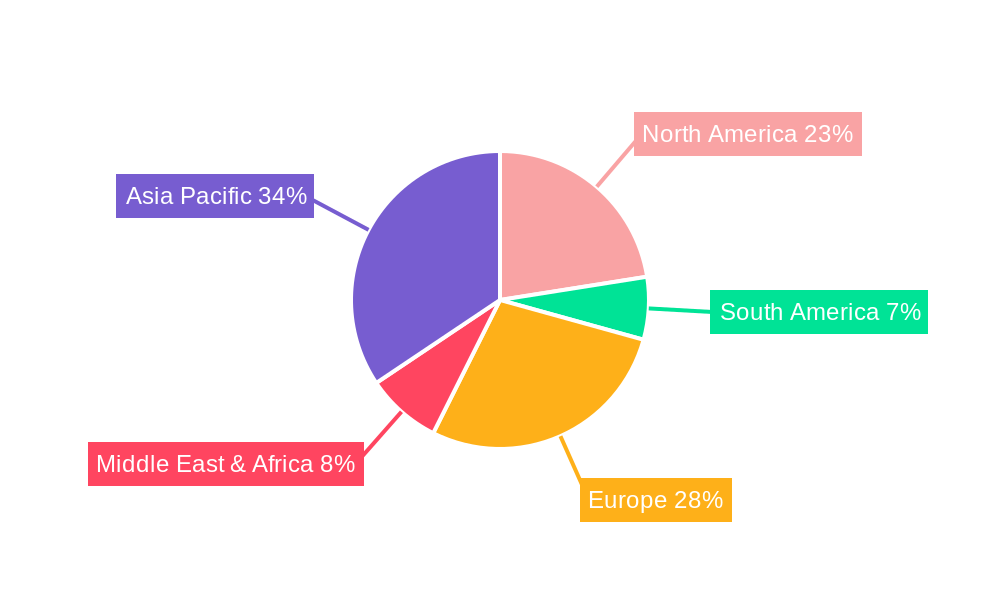
Lithium & Cobalt Recycling Regional Market Share
Geographic Coverage of Lithium & Cobalt Recycling
Lithium & Cobalt Recycling REPORT HIGHLIGHTS
| Aspects | Details |
|---|---|
| Study Period | 2020-2034 |
| Base Year | 2025 |
| Estimated Year | 2026 |
| Forecast Period | 2026-2034 |
| Historical Period | 2020-2025 |
| Growth Rate | CAGR of 22.24% from 2020-2034 |
| Segmentation |
|
Table of Contents
- 1. Introduction
- 1.1. Research Scope
- 1.2. Market Segmentation
- 1.3. Research Methodology
- 1.4. Definitions and Assumptions
- 2. Executive Summary
- 2.1. Introduction
- 3. Market Dynamics
- 3.1. Introduction
- 3.2. Market Drivers
- 3.3. Market Restrains
- 3.4. Market Trends
- 4. Market Factor Analysis
- 4.1. Porters Five Forces
- 4.2. Supply/Value Chain
- 4.3. PESTEL analysis
- 4.4. Market Entropy
- 4.5. Patent/Trademark Analysis
- 5. Global Lithium & Cobalt Recycling Analysis, Insights and Forecast, 2020-2032
- 5.1. Market Analysis, Insights and Forecast - by Application
- 5.1.1. Automotive
- 5.1.2. Marine
- 5.1.3. Industrial
- 5.1.4. Electric Power
- 5.2. Market Analysis, Insights and Forecast - by Types
- 5.2.1. Cobalt Recycling
- 5.2.2. Lithium Recycling
- 5.3. Market Analysis, Insights and Forecast - by Region
- 5.3.1. North America
- 5.3.2. South America
- 5.3.3. Europe
- 5.3.4. Middle East & Africa
- 5.3.5. Asia Pacific
- 5.1. Market Analysis, Insights and Forecast - by Application
- 6. North America Lithium & Cobalt Recycling Analysis, Insights and Forecast, 2020-2032
- 6.1. Market Analysis, Insights and Forecast - by Application
- 6.1.1. Automotive
- 6.1.2. Marine
- 6.1.3. Industrial
- 6.1.4. Electric Power
- 6.2. Market Analysis, Insights and Forecast - by Types
- 6.2.1. Cobalt Recycling
- 6.2.2. Lithium Recycling
- 6.1. Market Analysis, Insights and Forecast - by Application
- 7. South America Lithium & Cobalt Recycling Analysis, Insights and Forecast, 2020-2032
- 7.1. Market Analysis, Insights and Forecast - by Application
- 7.1.1. Automotive
- 7.1.2. Marine
- 7.1.3. Industrial
- 7.1.4. Electric Power
- 7.2. Market Analysis, Insights and Forecast - by Types
- 7.2.1. Cobalt Recycling
- 7.2.2. Lithium Recycling
- 7.1. Market Analysis, Insights and Forecast - by Application
- 8. Europe Lithium & Cobalt Recycling Analysis, Insights and Forecast, 2020-2032
- 8.1. Market Analysis, Insights and Forecast - by Application
- 8.1.1. Automotive
- 8.1.2. Marine
- 8.1.3. Industrial
- 8.1.4. Electric Power
- 8.2. Market Analysis, Insights and Forecast - by Types
- 8.2.1. Cobalt Recycling
- 8.2.2. Lithium Recycling
- 8.1. Market Analysis, Insights and Forecast - by Application
- 9. Middle East & Africa Lithium & Cobalt Recycling Analysis, Insights and Forecast, 2020-2032
- 9.1. Market Analysis, Insights and Forecast - by Application
- 9.1.1. Automotive
- 9.1.2. Marine
- 9.1.3. Industrial
- 9.1.4. Electric Power
- 9.2. Market Analysis, Insights and Forecast - by Types
- 9.2.1. Cobalt Recycling
- 9.2.2. Lithium Recycling
- 9.1. Market Analysis, Insights and Forecast - by Application
- 10. Asia Pacific Lithium & Cobalt Recycling Analysis, Insights and Forecast, 2020-2032
- 10.1. Market Analysis, Insights and Forecast - by Application
- 10.1.1. Automotive
- 10.1.2. Marine
- 10.1.3. Industrial
- 10.1.4. Electric Power
- 10.2. Market Analysis, Insights and Forecast - by Types
- 10.2.1. Cobalt Recycling
- 10.2.2. Lithium Recycling
- 10.1. Market Analysis, Insights and Forecast - by Application
- 11. Competitive Analysis
- 11.1. Global Market Share Analysis 2025
- 11.2. Company Profiles
- 11.2.1 Umicore
- 11.2.1.1. Overview
- 11.2.1.2. Products
- 11.2.1.3. SWOT Analysis
- 11.2.1.4. Recent Developments
- 11.2.1.5. Financials (Based on Availability)
- 11.2.2 GEM
- 11.2.2.1. Overview
- 11.2.2.2. Products
- 11.2.2.3. SWOT Analysis
- 11.2.2.4. Recent Developments
- 11.2.2.5. Financials (Based on Availability)
- 11.2.3 Brunp Recycling
- 11.2.3.1. Overview
- 11.2.3.2. Products
- 11.2.3.3. SWOT Analysis
- 11.2.3.4. Recent Developments
- 11.2.3.5. Financials (Based on Availability)
- 11.2.4 SungEel HiTech
- 11.2.4.1. Overview
- 11.2.4.2. Products
- 11.2.4.3. SWOT Analysis
- 11.2.4.4. Recent Developments
- 11.2.4.5. Financials (Based on Availability)
- 11.2.5 Taisen Recycling
- 11.2.5.1. Overview
- 11.2.5.2. Products
- 11.2.5.3. SWOT Analysis
- 11.2.5.4. Recent Developments
- 11.2.5.5. Financials (Based on Availability)
- 11.2.6 Batrec
- 11.2.6.1. Overview
- 11.2.6.2. Products
- 11.2.6.3. SWOT Analysis
- 11.2.6.4. Recent Developments
- 11.2.6.5. Financials (Based on Availability)
- 11.2.7 Retriev Technologies
- 11.2.7.1. Overview
- 11.2.7.2. Products
- 11.2.7.3. SWOT Analysis
- 11.2.7.4. Recent Developments
- 11.2.7.5. Financials (Based on Availability)
- 11.2.8 Tes-Amm(Recupyl)
- 11.2.8.1. Overview
- 11.2.8.2. Products
- 11.2.8.3. SWOT Analysis
- 11.2.8.4. Recent Developments
- 11.2.8.5. Financials (Based on Availability)
- 11.2.9 Duesenfeld
- 11.2.9.1. Overview
- 11.2.9.2. Products
- 11.2.9.3. SWOT Analysis
- 11.2.9.4. Recent Developments
- 11.2.9.5. Financials (Based on Availability)
- 11.2.10 4R Energy Corp
- 11.2.10.1. Overview
- 11.2.10.2. Products
- 11.2.10.3. SWOT Analysis
- 11.2.10.4. Recent Developments
- 11.2.10.5. Financials (Based on Availability)
- 11.2.11 OnTo Technology
- 11.2.11.1. Overview
- 11.2.11.2. Products
- 11.2.11.3. SWOT Analysis
- 11.2.11.4. Recent Developments
- 11.2.11.5. Financials (Based on Availability)
- 11.2.1 Umicore
List of Figures
- Figure 1: Global Lithium & Cobalt Recycling Revenue Breakdown (undefined, %) by Region 2025 & 2033
- Figure 2: North America Lithium & Cobalt Recycling Revenue (undefined), by Application 2025 & 2033
- Figure 3: North America Lithium & Cobalt Recycling Revenue Share (%), by Application 2025 & 2033
- Figure 4: North America Lithium & Cobalt Recycling Revenue (undefined), by Types 2025 & 2033
- Figure 5: North America Lithium & Cobalt Recycling Revenue Share (%), by Types 2025 & 2033
- Figure 6: North America Lithium & Cobalt Recycling Revenue (undefined), by Country 2025 & 2033
- Figure 7: North America Lithium & Cobalt Recycling Revenue Share (%), by Country 2025 & 2033
- Figure 8: South America Lithium & Cobalt Recycling Revenue (undefined), by Application 2025 & 2033
- Figure 9: South America Lithium & Cobalt Recycling Revenue Share (%), by Application 2025 & 2033
- Figure 10: South America Lithium & Cobalt Recycling Revenue (undefined), by Types 2025 & 2033
- Figure 11: South America Lithium & Cobalt Recycling Revenue Share (%), by Types 2025 & 2033
- Figure 12: South America Lithium & Cobalt Recycling Revenue (undefined), by Country 2025 & 2033
- Figure 13: South America Lithium & Cobalt Recycling Revenue Share (%), by Country 2025 & 2033
- Figure 14: Europe Lithium & Cobalt Recycling Revenue (undefined), by Application 2025 & 2033
- Figure 15: Europe Lithium & Cobalt Recycling Revenue Share (%), by Application 2025 & 2033
- Figure 16: Europe Lithium & Cobalt Recycling Revenue (undefined), by Types 2025 & 2033
- Figure 17: Europe Lithium & Cobalt Recycling Revenue Share (%), by Types 2025 & 2033
- Figure 18: Europe Lithium & Cobalt Recycling Revenue (undefined), by Country 2025 & 2033
- Figure 19: Europe Lithium & Cobalt Recycling Revenue Share (%), by Country 2025 & 2033
- Figure 20: Middle East & Africa Lithium & Cobalt Recycling Revenue (undefined), by Application 2025 & 2033
- Figure 21: Middle East & Africa Lithium & Cobalt Recycling Revenue Share (%), by Application 2025 & 2033
- Figure 22: Middle East & Africa Lithium & Cobalt Recycling Revenue (undefined), by Types 2025 & 2033
- Figure 23: Middle East & Africa Lithium & Cobalt Recycling Revenue Share (%), by Types 2025 & 2033
- Figure 24: Middle East & Africa Lithium & Cobalt Recycling Revenue (undefined), by Country 2025 & 2033
- Figure 25: Middle East & Africa Lithium & Cobalt Recycling Revenue Share (%), by Country 2025 & 2033
- Figure 26: Asia Pacific Lithium & Cobalt Recycling Revenue (undefined), by Application 2025 & 2033
- Figure 27: Asia Pacific Lithium & Cobalt Recycling Revenue Share (%), by Application 2025 & 2033
- Figure 28: Asia Pacific Lithium & Cobalt Recycling Revenue (undefined), by Types 2025 & 2033
- Figure 29: Asia Pacific Lithium & Cobalt Recycling Revenue Share (%), by Types 2025 & 2033
- Figure 30: Asia Pacific Lithium & Cobalt Recycling Revenue (undefined), by Country 2025 & 2033
- Figure 31: Asia Pacific Lithium & Cobalt Recycling Revenue Share (%), by Country 2025 & 2033
List of Tables
- Table 1: Global Lithium & Cobalt Recycling Revenue undefined Forecast, by Application 2020 & 2033
- Table 2: Global Lithium & Cobalt Recycling Revenue undefined Forecast, by Types 2020 & 2033
- Table 3: Global Lithium & Cobalt Recycling Revenue undefined Forecast, by Region 2020 & 2033
- Table 4: Global Lithium & Cobalt Recycling Revenue undefined Forecast, by Application 2020 & 2033
- Table 5: Global Lithium & Cobalt Recycling Revenue undefined Forecast, by Types 2020 & 2033
- Table 6: Global Lithium & Cobalt Recycling Revenue undefined Forecast, by Country 2020 & 2033
- Table 7: United States Lithium & Cobalt Recycling Revenue (undefined) Forecast, by Application 2020 & 2033
- Table 8: Canada Lithium & Cobalt Recycling Revenue (undefined) Forecast, by Application 2020 & 2033
- Table 9: Mexico Lithium & Cobalt Recycling Revenue (undefined) Forecast, by Application 2020 & 2033
- Table 10: Global Lithium & Cobalt Recycling Revenue undefined Forecast, by Application 2020 & 2033
- Table 11: Global Lithium & Cobalt Recycling Revenue undefined Forecast, by Types 2020 & 2033
- Table 12: Global Lithium & Cobalt Recycling Revenue undefined Forecast, by Country 2020 & 2033
- Table 13: Brazil Lithium & Cobalt Recycling Revenue (undefined) Forecast, by Application 2020 & 2033
- Table 14: Argentina Lithium & Cobalt Recycling Revenue (undefined) Forecast, by Application 2020 & 2033
- Table 15: Rest of South America Lithium & Cobalt Recycling Revenue (undefined) Forecast, by Application 2020 & 2033
- Table 16: Global Lithium & Cobalt Recycling Revenue undefined Forecast, by Application 2020 & 2033
- Table 17: Global Lithium & Cobalt Recycling Revenue undefined Forecast, by Types 2020 & 2033
- Table 18: Global Lithium & Cobalt Recycling Revenue undefined Forecast, by Country 2020 & 2033
- Table 19: United Kingdom Lithium & Cobalt Recycling Revenue (undefined) Forecast, by Application 2020 & 2033
- Table 20: Germany Lithium & Cobalt Recycling Revenue (undefined) Forecast, by Application 2020 & 2033
- Table 21: France Lithium & Cobalt Recycling Revenue (undefined) Forecast, by Application 2020 & 2033
- Table 22: Italy Lithium & Cobalt Recycling Revenue (undefined) Forecast, by Application 2020 & 2033
- Table 23: Spain Lithium & Cobalt Recycling Revenue (undefined) Forecast, by Application 2020 & 2033
- Table 24: Russia Lithium & Cobalt Recycling Revenue (undefined) Forecast, by Application 2020 & 2033
- Table 25: Benelux Lithium & Cobalt Recycling Revenue (undefined) Forecast, by Application 2020 & 2033
- Table 26: Nordics Lithium & Cobalt Recycling Revenue (undefined) Forecast, by Application 2020 & 2033
- Table 27: Rest of Europe Lithium & Cobalt Recycling Revenue (undefined) Forecast, by Application 2020 & 2033
- Table 28: Global Lithium & Cobalt Recycling Revenue undefined Forecast, by Application 2020 & 2033
- Table 29: Global Lithium & Cobalt Recycling Revenue undefined Forecast, by Types 2020 & 2033
- Table 30: Global Lithium & Cobalt Recycling Revenue undefined Forecast, by Country 2020 & 2033
- Table 31: Turkey Lithium & Cobalt Recycling Revenue (undefined) Forecast, by Application 2020 & 2033
- Table 32: Israel Lithium & Cobalt Recycling Revenue (undefined) Forecast, by Application 2020 & 2033
- Table 33: GCC Lithium & Cobalt Recycling Revenue (undefined) Forecast, by Application 2020 & 2033
- Table 34: North Africa Lithium & Cobalt Recycling Revenue (undefined) Forecast, by Application 2020 & 2033
- Table 35: South Africa Lithium & Cobalt Recycling Revenue (undefined) Forecast, by Application 2020 & 2033
- Table 36: Rest of Middle East & Africa Lithium & Cobalt Recycling Revenue (undefined) Forecast, by Application 2020 & 2033
- Table 37: Global Lithium & Cobalt Recycling Revenue undefined Forecast, by Application 2020 & 2033
- Table 38: Global Lithium & Cobalt Recycling Revenue undefined Forecast, by Types 2020 & 2033
- Table 39: Global Lithium & Cobalt Recycling Revenue undefined Forecast, by Country 2020 & 2033
- Table 40: China Lithium & Cobalt Recycling Revenue (undefined) Forecast, by Application 2020 & 2033
- Table 41: India Lithium & Cobalt Recycling Revenue (undefined) Forecast, by Application 2020 & 2033
- Table 42: Japan Lithium & Cobalt Recycling Revenue (undefined) Forecast, by Application 2020 & 2033
- Table 43: South Korea Lithium & Cobalt Recycling Revenue (undefined) Forecast, by Application 2020 & 2033
- Table 44: ASEAN Lithium & Cobalt Recycling Revenue (undefined) Forecast, by Application 2020 & 2033
- Table 45: Oceania Lithium & Cobalt Recycling Revenue (undefined) Forecast, by Application 2020 & 2033
- Table 46: Rest of Asia Pacific Lithium & Cobalt Recycling Revenue (undefined) Forecast, by Application 2020 & 2033
Frequently Asked Questions
1. What is the projected Compound Annual Growth Rate (CAGR) of the Lithium & Cobalt Recycling?
The projected CAGR is approximately 22.24%.
2. Which companies are prominent players in the Lithium & Cobalt Recycling?
Key companies in the market include Umicore, GEM, Brunp Recycling, SungEel HiTech, Taisen Recycling, Batrec, Retriev Technologies, Tes-Amm(Recupyl), Duesenfeld, 4R Energy Corp, OnTo Technology.
3. What are the main segments of the Lithium & Cobalt Recycling?
The market segments include Application, Types.
4. Can you provide details about the market size?
The market size is estimated to be USD XXX N/A as of 2022.
5. What are some drivers contributing to market growth?
N/A
6. What are the notable trends driving market growth?
N/A
7. Are there any restraints impacting market growth?
N/A
8. Can you provide examples of recent developments in the market?
N/A
9. What pricing options are available for accessing the report?
Pricing options include single-user, multi-user, and enterprise licenses priced at USD 4900.00, USD 7350.00, and USD 9800.00 respectively.
10. Is the market size provided in terms of value or volume?
The market size is provided in terms of value, measured in N/A.
11. Are there any specific market keywords associated with the report?
Yes, the market keyword associated with the report is "Lithium & Cobalt Recycling," which aids in identifying and referencing the specific market segment covered.
12. How do I determine which pricing option suits my needs best?
The pricing options vary based on user requirements and access needs. Individual users may opt for single-user licenses, while businesses requiring broader access may choose multi-user or enterprise licenses for cost-effective access to the report.
13. Are there any additional resources or data provided in the Lithium & Cobalt Recycling report?
While the report offers comprehensive insights, it's advisable to review the specific contents or supplementary materials provided to ascertain if additional resources or data are available.
14. How can I stay updated on further developments or reports in the Lithium & Cobalt Recycling?
To stay informed about further developments, trends, and reports in the Lithium & Cobalt Recycling, consider subscribing to industry newsletters, following relevant companies and organizations, or regularly checking reputable industry news sources and publications.
Methodology
Step 1 - Identification of Relevant Samples Size from Population Database



Step 2 - Approaches for Defining Global Market Size (Value, Volume* & Price*)

Note*: In applicable scenarios
Step 3 - Data Sources
Primary Research
- Web Analytics
- Survey Reports
- Research Institute
- Latest Research Reports
- Opinion Leaders
Secondary Research
- Annual Reports
- White Paper
- Latest Press Release
- Industry Association
- Paid Database
- Investor Presentations

Step 4 - Data Triangulation
Involves using different sources of information in order to increase the validity of a study
These sources are likely to be stakeholders in a program - participants, other researchers, program staff, other community members, and so on.
Then we put all data in single framework & apply various statistical tools to find out the dynamic on the market.
During the analysis stage, feedback from the stakeholder groups would be compared to determine areas of agreement as well as areas of divergence